


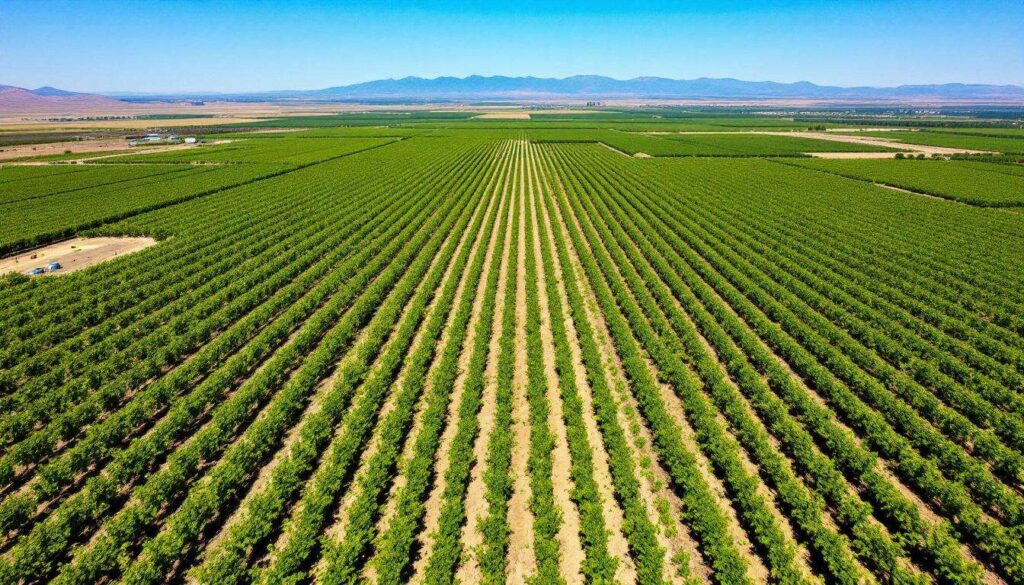
China’s remarkable achievement in transforming a vast expanse of barren desert into productive agricultural land stands as one of the most impressive environmental success stories of recent decades. The Mu Us Desert, spanning an area larger than Brittany, has undergone a dramatic metamorphosis from an inhospitable wasteland into fertile terrain capable of producing high-quality apples and other crops. This extraordinary feat demonstrates how determined human intervention, combined with scientific innovation and sustained effort, can reverse centuries of desertification and create sustainable ecosystems where none existed before.
Transformation of the Mu Us Desert
Historical context of desertification
The Mu Us Desert, located in northern China across Inner Mongolia and Shaanxi Province, covered approximately 42,200 square kilometres of land. For centuries, this region suffered from severe desertification caused by overgrazing, deforestation, and unsustainable agricultural practices. The shifting sands threatened nearby communities and agricultural areas, forcing thousands of residents to abandon their homes. Historical records indicate that the desert expanded significantly during the 20th century, consuming previously arable land and disrupting local livelihoods.
Large-scale reforestation programme
China launched an ambitious reforestation initiative spanning several decades to combat the desert’s advance. The programme involved:
- Planting billions of trees and shrubs adapted to arid conditions
- Creating protective forest belts to stabilise sand dunes
- Establishing vegetation corridors to prevent sand migration
- Implementing strict grazing controls and land-use regulations
Local authorities mobilised entire communities, with residents participating in mass tree-planting campaigns. The government provided financial incentives to families who successfully established vegetation on previously barren land, creating a direct link between environmental restoration and economic benefit.
Measurable results achieved
| Indicator | Before restoration | After restoration |
|---|---|---|
| Forest coverage | Less than 5% | Over 93% |
| Vegetation area | Minimal | 600,000 hectares |
| Sand mobility | High | Significantly reduced |
These achievements represent a fundamental shift in the region’s ecological balance, with the desert now largely stabilised and productive. The success of this transformation has laid the groundwork for developing more sophisticated agricultural systems in areas once considered permanently lost to cultivation.
Innovative agricultural techniques
Water management systems
The introduction of advanced irrigation technology has been crucial to agricultural development in the former desert region. Farmers now employ drip irrigation systems that deliver water directly to plant roots, minimising waste and maximising efficiency. These systems use sensors to monitor soil moisture levels and automatically adjust water delivery based on plant needs. Underground water reserves, previously untapped, have been accessed through carefully managed wells that ensure sustainable extraction rates without depleting aquifers.
Soil improvement strategies
Transforming sand into productive soil required comprehensive soil amendment programmes. Agricultural specialists implemented several key approaches:
- Adding organic matter and compost to increase nutrient content
- Incorporating clay particles to improve water retention
- Introducing beneficial microorganisms to enhance soil biology
- Applying mulches to reduce evaporation and moderate soil temperature
- Planting nitrogen-fixing cover crops between main growing seasons
These interventions gradually built up soil structure and fertility, creating conditions suitable for cultivating fruit trees and other crops. The process required patience and sustained investment, with soil quality improving incrementally over multiple growing seasons.
Selection of appropriate crop varieties
Agricultural researchers identified apple varieties particularly well-suited to the region’s unique environmental conditions. These cultivars demonstrate exceptional drought tolerance whilst maintaining commercial quality standards. Scientists also developed new hybrid varieties specifically bred for the region’s climate, combining resilience with marketable characteristics such as flavour, colour, and storage life. The careful matching of crops to environmental conditions has been fundamental to achieving viable agricultural production in this challenging landscape.
Restoration of arid land
Ecological engineering principles
The restoration effort applied sophisticated ecological engineering concepts to recreate functional ecosystems. Rather than simply planting trees randomly, planners designed vegetation patterns that mimic natural ecological succession. Pioneer species established initial ground cover, creating microclimates that enabled more demanding plants to survive. This staged approach recognised that ecosystem development follows predictable patterns, with each phase preparing conditions for the next.
Biodiversity enhancement
Successful land restoration extended beyond establishing vegetation to rebuilding entire ecological communities. The project reintroduced native plant species that had disappeared from the region, creating habitat for wildlife that had previously abandoned the area. Bird populations have returned in significant numbers, whilst insect diversity has increased dramatically. This biodiversity recovery contributes to ecosystem resilience and provides natural pest control for agricultural operations.
Climate regulation benefits
The transformation has produced measurable impacts on local climate conditions:
- Increased humidity levels due to plant transpiration
- Reduced temperature extremes through vegetation shading
- Enhanced precipitation patterns from improved moisture cycling
- Decreased wind speeds and dust storm frequency
These changes create a positive feedback loop, with improved climatic conditions supporting further vegetation establishment and agricultural development. The restored landscape now functions as a productive ecosystem rather than a source of environmental degradation, demonstrating how comprehensive restoration can fundamentally alter regional environmental dynamics.
Sustainable fruit production
Apple cultivation methods
Modern orchard management practices have been adapted to the region’s specific requirements. Farmers utilise high-density planting configurations that maximise land use efficiency whilst maintaining adequate spacing for mechanised operations. Pruning techniques optimise sunlight exposure and air circulation, reducing disease pressure and improving fruit quality. Integrated pest management strategies minimise chemical inputs by combining biological controls, cultural practices, and targeted interventions only when necessary.
Quality and market characteristics
Apples produced in the restored desert region have gained recognition for their distinctive qualities. The significant temperature variation between day and night promotes sugar accumulation and colour development, resulting in particularly flavourful and visually appealing fruit. The region’s low humidity reduces fungal disease pressure, allowing reduced pesticide applications. These factors combine to produce premium-quality apples that command favourable prices in domestic and international markets.
Environmental sustainability measures
| Practice | Environmental benefit |
|---|---|
| Drip irrigation | 90% water use efficiency |
| Organic amendments | Carbon sequestration in soil |
| Integrated pest management | Reduced chemical inputs |
| Cover cropping | Erosion prevention and soil building |
These practices ensure that agricultural production enhances rather than degrades the restored environment, creating a model for sustainable intensive agriculture in challenging conditions. The approach demonstrates that productivity and environmental stewardship can advance together when appropriate technologies and management systems are employed.
Impact on the local economy
Employment generation
The transformation has created thousands of jobs across multiple sectors. Direct agricultural employment includes orchard workers, irrigation technicians, and harvest labour. Supporting industries have emerged, including packing facilities, cold storage operations, and transport services. Agricultural supply businesses provide inputs such as fertilisers, equipment, and technical services. This economic diversification has stabilised communities that previously faced declining prospects due to environmental degradation.
Income improvements for residents
Families participating in fruit production have experienced substantial income increases compared to previous livelihoods. Apple cultivation generates significantly higher returns per hectare than traditional crops or livestock grazing. Government support programmes have helped farmers access credit for establishing orchards and purchasing equipment. Cooperative marketing arrangements enable small producers to access premium markets and negotiate favourable prices, ensuring that economic benefits reach individual farming households rather than concentrating with intermediaries.
Regional development effects
The agricultural transformation has catalysed broader economic development throughout the region:
- Infrastructure improvements including roads and electricity networks
- Development of processing facilities adding value to raw production
- Growth of service sectors supporting agricultural operations
- Increased tax revenues enabling public investment in education and healthcare
- Population stabilisation reversing previous out-migration trends
These changes have fundamentally altered the region’s economic trajectory, transforming it from an area of poverty and environmental crisis into a zone of prosperity and opportunity. The success demonstrates how environmental restoration can serve as a foundation for comprehensive rural development.
Example for global agriculture
Replicability in other arid regions
The Mu Us transformation offers valuable lessons for combating desertification worldwide. The project’s success demonstrates that even severely degraded landscapes can be restored through sustained effort and appropriate techniques. Similar conditions exist across vast areas of Africa, the Middle East, Central Asia, and other regions facing desertification pressures. The fundamental principles applied in China—comprehensive planning, staged implementation, community participation, and long-term commitment—can be adapted to different cultural and environmental contexts.
Technical knowledge transfer
China has begun sharing expertise gained from the Mu Us project with other countries. Technical training programmes bring foreign specialists to observe successful practices firsthand. Chinese agricultural experts provide consulting services to governments planning similar initiatives. International research collaborations are developing technologies specifically suited to different arid environments. This knowledge exchange accelerates global capacity for addressing desertification and expanding agricultural production in marginal lands.
Policy and investment implications
The project illustrates the importance of sustained government commitment and strategic investment in environmental restoration. Success required decades of consistent funding, supportive policies, and institutional coordination. The economic returns, whilst substantial, materialised only after years of investment without immediate payback. This reality highlights the need for patient capital and long-term planning horizons when undertaking large-scale environmental restoration. The eventual economic benefits, however, demonstrate that such investments can generate significant returns whilst addressing critical environmental challenges.
The transformation of the Mu Us Desert from barren wasteland to productive agricultural landscape represents a triumph of human ingenuity and determination. Through comprehensive reforestation, innovative agricultural techniques, and sustained commitment, China has demonstrated that severe environmental degradation can be reversed. The region now produces high-quality apples and supports thriving communities where desert once dominated. This achievement offers hope and practical guidance for addressing desertification globally, showing that with appropriate approaches and sufficient dedication, humanity can restore damaged ecosystems whilst building prosperous rural economies. The lessons from this remarkable project extend far beyond China’s borders, providing a blueprint for sustainable development in arid regions worldwide.