


Creating a thriving perennial garden requires more than simply choosing attractive plants. Understanding which species work well together and which should be kept apart is essential for long-term success. Certain perennials have conflicting requirements for water, sunlight, and soil conditions, making them incompatible neighbours. When planted together, these mismatched pairs compete for resources, leading to weakened plants, poor flowering, and increased susceptibility to disease. By recognising these problematic combinations, gardeners can avoid costly mistakes and create harmonious planting schemes that flourish year after year.
Why some perennials don’t get along
Conflicting environmental needs
The primary reason certain perennials fail when planted together stems from fundamentally different environmental requirements. Some species evolved in dry, sunny Mediterranean climates whilst others developed in moist woodland settings. When forced to share space, one plant inevitably suffers as the conditions favour its companion. This botanical incompatibility manifests in several ways:
- Water requirements: drought-tolerant plants versus moisture-loving species
- Light preferences: sun-worshippers versus shade-dwellers
- Soil pH: acid-loving plants versus those preferring alkaline conditions
- Nutrient demands: heavy feeders competing with light feeders
Competition for resources
Beyond environmental preferences, perennials may struggle together due to resource competition. Vigorous growers with extensive root systems can monopolise water and nutrients, starving neighbouring plants. Similarly, tall specimens may cast unwanted shade over sun-loving companions, whilst aggressive spreaders can physically crowd out less assertive species. Understanding these competitive dynamics helps gardeners create balanced plantings where each specimen has adequate space and resources to thrive.
Disease susceptibility
Certain plant combinations create conditions that encourage fungal diseases and pest problems. When shade-loving plants are paired with those requiring full sun, the resulting compromise often produces poor air circulation and excessive humidity. These conditions become breeding grounds for powdery mildew, rust, and other fungal infections that can devastate an entire border.
Recognising these fundamental incompatibilities allows gardeners to make informed decisions when planning their perennial borders, ensuring each plant receives the conditions it requires.
Lavender and hostas: a pairing to avoid
Opposite moisture requirements
This combination represents one of the most common mistakes in perennial gardening. Lavender thrives in dry, well-drained soil with minimal water, reflecting its Mediterranean origins where summer drought is the norm. Hostas, conversely, evolved in moist Asian woodlands and require consistently damp soil to maintain their lush foliage. When planted together, these opposing needs create an impossible situation where one plant must suffer.
| Plant characteristic | Lavender | Hostas |
|---|---|---|
| Light requirement | Full sun (6+ hours) | Partial to full shade |
| Water needs | Low, drought-tolerant | High, consistently moist |
| Soil preference | Sandy, well-drained | Rich, moisture-retentive |
| pH preference | Alkaline to neutral | Slightly acidic to neutral |
Light exposure conflicts
The lighting requirements compound the moisture problem. Lavender demands full sun exposure to produce its aromatic oils and vibrant purple blooms, whilst hostas develop their best foliage colouration in shade. In full sun, hosta leaves scorch and fade, particularly variegated varieties. In shade, lavender becomes leggy, fails to flower, and becomes prone to fungal problems.
Practical consequences
Gardeners who attempt this pairing typically find that watering to satisfy the hostas leads to root rot in the lavender. Conversely, providing the dry conditions lavender requires causes hostas to develop brown leaf edges and stunted growth. Neither plant achieves its potential, resulting in a disappointing display that requires constant intervention.
Understanding these fundamental differences helps explain why other moisture-mismatched combinations also fail in the garden.
Phlox and hostas: what are the consequences ?
The mildew problem
Whilst both phlox and hostas appreciate moisture, their combination creates ideal conditions for powdery mildew. Garden phlox naturally suffers from this fungal disease, particularly when air circulation is poor. The dense foliage of hostas restricts airflow around phlox stems, creating the humid, stagnant conditions that encourage mildew spores to germinate and spread rapidly.
Shade versus sun requirements
Garden phlox performs best in full sun to light shade, requiring good light penetration to flower prolifically. Hostas, particularly blue-leaved varieties, need significant shade protection. When planted together, the compromise typically involves partial shade conditions that suit neither plant perfectly. The phlox produces fewer flowers and weaker stems, whilst the hostas may experience leaf bleaching.
Disease management challenges
Once powdery mildew establishes itself on phlox in a mixed planting with hostas, control becomes extremely difficult. The disease manifests as:
- White powdery coating on leaves and stems
- Distorted new growth and reduced flowering
- Premature leaf drop and weakened plants
- Spread to other susceptible plants in the vicinity
The proximity of hosta foliage makes fungicide application less effective and prevents the air circulation necessary for natural disease suppression. This problematic pairing demonstrates how compatible moisture needs don’t guarantee successful combinations.
Similar challenges arise when plants compete for light and space, as seen with other tall and short perennial combinations.
Peonies and delphiniums: beware of antagonisms
Height and light competition
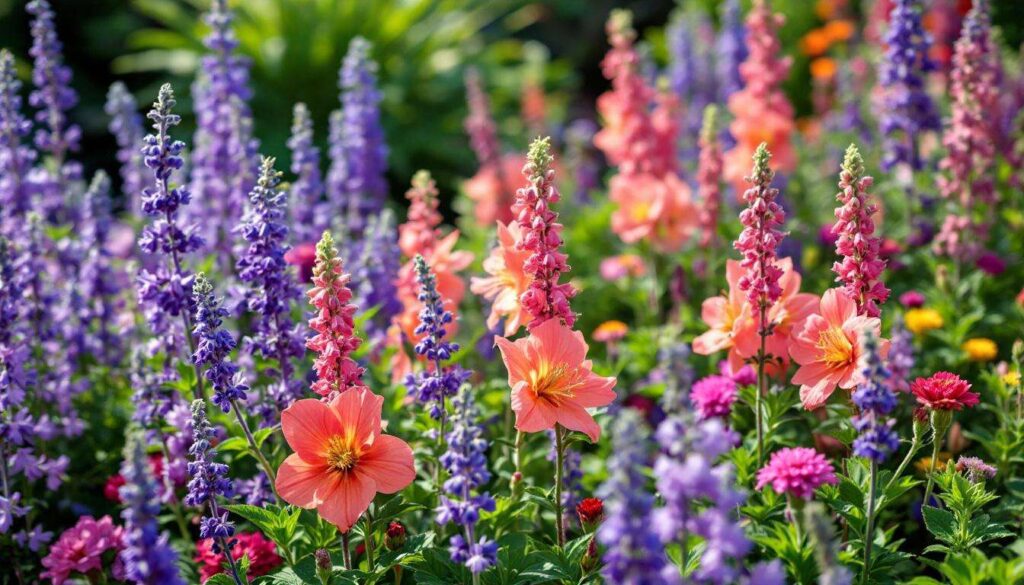
Both peonies and delphiniums are substantial border plants with significant presence, but their growth habits create conflict. Mature peony foliage forms dense mounds that can spread 90 centimetres or more, creating substantial shade beneath their canopy. Delphiniums require full sun throughout their height to produce strong stems and abundant flower spikes. When peonies cast shade on delphiniums, the latter develop weak, floppy stems that require excessive staking.
Nutrient competition
Both species are heavy feeders that demand rich soil and regular fertilisation. Their extensive root systems compete aggressively for available nutrients, particularly nitrogen and phosphorus. This competition results in:
- Reduced flower size and quantity on both plants
- Shorter bloom periods and diminished colour intensity
- Increased susceptibility to pest and disease problems
- Overall decline in plant vigour over successive seasons
Spacing and airflow issues
The substantial foliage of peonies restricts air circulation around delphinium stems, increasing humidity levels that encourage fungal diseases. Delphiniums are particularly susceptible to crown rot and powdery mildew in stagnant air conditions. The close proximity required in typical border plantings exacerbates these problems, creating a cycle of disease and decline that affects both species.
These competitive dynamics also appear when pairing plants with different growth rates and spreading habits.
Heuchera and Japanese anemones: the wrong match
Root zone conflicts
Japanese anemones spread vigorously through underground runners, creating extensive root networks that can overwhelm neighbouring plants. Heuchera, with their relatively compact root systems, cannot compete with this aggressive expansion. The anemone roots physically displace heuchera crowns, disrupting their establishment and leading to gradual decline.
Moisture and fertility demands
Whilst both plants tolerate partial shade, their soil preferences differ significantly. Japanese anemones thrive in consistently moist, fertile soil and spread more aggressively under these conditions. Heuchera prefer moderately moist soil with excellent drainage, becoming susceptible to crown rot in overly wet conditions. Creating soil conditions that satisfy the vigorous anemones typically proves too wet for heuchera health.
| Growth characteristic | Heuchera | Japanese anemones |
|---|---|---|
| Spread rate | Slow, clump-forming | Fast, aggressive runners |
| Root depth | Shallow, compact | Deep, extensive network |
| Drainage needs | Excellent drainage essential | Tolerates heavier soils |
| Maintenance | Low, occasional division | Requires containment |
Long-term viability
Over time, Japanese anemones inevitably dominate this pairing, gradually encroaching upon heuchera space. The heuchera become stressed, produce fewer flowers, and their distinctive foliage loses vigour. Attempting to control the anemones through division often disturbs heuchera roots, further compromising their health.
Similar aggressive behaviour characterises other vigorous spreaders that prove problematic companions for less assertive plants.
Mint and strawberries: rivalry in the vegetable garden
Aggressive spreading behaviour
Mint ranks among the most invasive perennial herbs, spreading rapidly through underground stolons that can travel considerable distances. Strawberries also spread through runners, but at a more controlled pace. When planted together, mint quickly overwhelms strawberry plants, competing for space, nutrients, and water. The mint’s dense root mat prevents strawberry runners from establishing, effectively strangling the fruit crop.
Allelopathic effects
Mint produces chemical compounds that can inhibit the growth of neighbouring plants, a phenomenon known as allelopathy. These compounds, released through root exudates and decomposing plant material, may suppress strawberry growth and fruit production. The effects include:
- Reduced strawberry plant vigour and runner production
- Smaller fruit size and diminished flavour
- Delayed flowering and shortened harvest period
- Increased susceptibility to strawberry-specific pests and diseases
Harvest and maintenance complications
The practical challenges of this combination extend beyond plant health. Harvesting strawberries becomes difficult when mint has infiltrated the planting, as the herbs entangle with fruit-bearing stems. Mint’s strong flavour can transfer to strawberries through contact, affecting their taste. Additionally, controlling mint without disturbing shallow strawberry roots proves nearly impossible, making this one of the most problematic edible plant combinations.
Careful planning and understanding these incompatibilities ensures perennial gardens remain healthy and productive. Selecting companions with similar environmental needs, compatible growth habits, and complementary resource requirements creates harmonious plantings that thrive with minimal intervention. By avoiding these common mismatched pairings, gardeners establish borders that deliver years of reliable beauty and satisfaction.